CLICK HERE FOR FREE BLOG LAYOUTS, LINK BUTTONS AND MORE! »
Showing posts with label Islam. Show all posts

1/7/09

Ready or not, some day it will all come to an end.....

A Message to share:

~There will be no more sunrises, no minutes, hours or days. All the things you collected, whether treasured or forgotten, will pass to someone else. Your wealth, fame and temporal power will shrivel to irrelevance. It will not matter what you owned or what you were owed. Your grudges, resentments, frustrations, and jealousies will finally disappear.

~So, too, your hopes, ambitions, plans, and to-do lists will expire. The wins and losses that once seemed so important will fade away. It won't matter where you came from, or on what side of the tracks you lived, at the end. It won't matter whether you were beautiful or brilliant.
~Even your gender and skin color will be irrelevant.

~So what will matter? How will the value of your days be measured?
~What will matter is not what you bought, but what you built; not what you got, but what you gave. What will matter is not your success, but your significance. What will matter is not what you learned, but what you taught. What will matter is every act of integrity, compassion, courage or sacrifice that enriched, empowered or encouraged others to emulate your example.

~What will matter is not your competence, but your character. What will matter is not how many people you knew, but how many will feel a lasting loss when you're gone. What will matter are not your memories, but the memories that live in those who loved you. What will matter is how long you will be remembered, by whom and for what.
~ Living a life that matters doesn't happen by accident. It's not a matter of circumstance but of choice.
~Choose to live a life that matters.
~"We make a living by what we get; we make a life by what we give"

11/26/08

Dealing with Differences

After reading some of the comments made in the Jilbab fard/not fard discussion, I wanted to share this article on how I think we should deal with each other when we have different points of view on certain Islamic topics


"Islam teaches that wudu is done this way." The man said confidently.

"But you're wrong," the young man replied. "That's totally against the laws of Islam."

"But it says in a hadith that." The older man started saying.

"That's a weak hadith!" The younger man interrupted.

"Oh Yeah! What's your daleel (proof)? I read in a book that the blessed prophet said to..."

By this time both men were fuming. The young man screamed, "I read in a book, too, that..."

But before he could finish his sentence, the older brother pushed him and he pushed back. A fight would ensued if some quick-thinking brothers nearby didn't break it up.

The two brothers eyed each other angrily and left in opposite directions. Those who remained just shook their heads in silence. Here were two brothers ready to fight over a difference of opinion.

The funny thing was, they both were right. They just didn't know how to handle a difference of opinion. The blessed prophet once remarked:Difference (of opinion) in my Ummah are a blessing."

He didn't mean that Muslims should argue about everything or be divided, rather, he was pointing out that it was good for Muslims to think, to reason together, to discuss things and that if they disagreed over something, that it was all in the pursuit of knowledge. If anyone uses differences of opinion to form competing groups, then they have done wrong and may find themselves in trouble on the day of judgment!

Allah is very harsh against those who make divisions. He said, "And be not like those who split up their way of life and become mere sects, each group rejoicing in what it (claims) it has." (Qur'an 30:31-32).

Also he said, "As for those who divide their way of life and break up into sects, you have no part of them at all. Their affair is with Allah. He will tell them the truth of what they did in the end." (Qur'an 6:159).

Once the Prophet Muhammad (pbuh), said that the Jews divided up into 71 sects, or groups, the Christians into 72 and that his community would eventually be divided up into 73. Then he said they would all be in the fire except one. When the people around him asked which one was going to Paradise, he replied that it was the one which would follow his example.

We are blessed as a community in that we have our original book and the complete record of the life of our prophet. If anyone comes and says, "This or that is Islam," we can easily check and verify whether or not it's true. If it doesn't come from the Qur'an or Hadith, then it can't be Islam. So we must use those two sources to explain what Islam really is. Sincere people seek to learn and practice the truth and Allah guides those who seek him. Anything else is opinion.

On many occasions Muslims have disagreed over what something means or what to do. The key is to follow the Islamic manners of how to deal with differences. We don't have to agree all the time, but we don't fight over disagreements as if we were enemies. And if we are truly wrong and realize it, we must not stick to a false position out of pride or fear of "losing."

An arrogant person refuses to accept logic and a proud and vain person never likes to listen to guidance. In contrast, the Qur'an states, "Those who, when they hear the signs of Allah being recited, humble themselves" So be humble where knowledge is concerned.

Before the battle of Khandaq, the Muslims had to decide what to do. Some wanted to go out and fight while others wanted to stay in the city and defend from there. The prophet listened to both sides and in the end, he agreed with those who wanted to defend from the city. He didn't barge in with his own personal preferences nor did the Shura, or group discussion, become heated and full of antagonism. People disagreed over an issue but united after a majority decision was taken.

Allah, the exalted, gave us a formula for dealing with differences when he said in the Qur'an that this book is Al Furqan, the standard to go by. And further he instructed us to follow the example of the blessed prophet (Qur'an 33:21)

If we have a disagreement, especially between the followers of one Madhab (School of Fiqh) and another, we must respect each other's opinions and present our evidence. In the end, even if neither side proves a point, we must be courteous and respectful. If we find our position is wrong, then we would be a fool to stick with something that is not true. Simply say, "Alhumdulillah," and thank the brother or sister for helping you to understand Allah's Shari'ah better. Khalifa 'Umar once said, "Allah bless the person who makes me a gift of my own faults."

I've seen countless showdowns between people with different opinions in which the end-result was ill will and hurt feelings. What's even worse is that such a display of rude behavior on the part of people who are supposed to know Islam makes other Muslims shy away from the Masjid and Muslim gatherings. It has an even worse effect on new converts and potential converts. Muslims handle their differences with proper adab, or manners.

When we have differences, we must not forget that it does not take away from our primary bonds of Iman. On one occasion, Khalid ibn Walid and Saad ibn Waqqas were having a heated argument. After Khalid left, a friend of Saad's started saying bad things about Khalid. Saad immediately stopped the man and told him, "The disagreement between us does not affect the bond of our Iman." (From: God-Oriented Life)

Once 'Umar ibn al-Khattab, who was the Khalifa, or political leader, went up to a person he disliked and told him to his face, "I don't like you." The person merely answered back, "Are you going to take away my rights?" Umar replied, "I don't like you, but I will respect your rights." Clearly, that is the best example for us to follow with regards to dealing with the differences among us.

10/17/08

My dawah of the day

I have been pretty busy at work recently. I'm currently working on two reports on the economic impact of health centers in Michigan and Wisconsin and I have to decipher a lot of data! Anyways, don't wanna bore you with my job :)

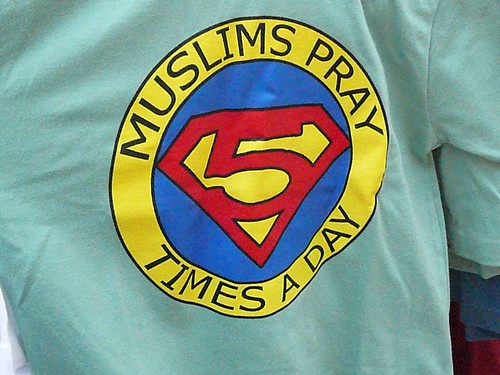
On another note my friend Vanessa and I had a good conversation yesterday about religion. Vanessa is from the Philippines, and she is Christian, she knows I'm muslim but we've never really talked about our religious beliefs. Though we spend a lot of time together, I realized that Vanessa doesn't know what I beleive in. It all started when she complained that she had to get up at 6:00 am yesterday. I told her it wasn't that bad since I wake up at that time every day to pray for Fajr. Now that beats the hell out of her! Vanessa could not comprehend why I had to pray 5 times a day! Here's how the conversation went:

Vanessa: You pray 5 times a day? 5 times?
Me: Yes
Vanessa: Oh My Gosh, even on weekends?
Me: No, not on my day off....duh of course on weekends too lol.
Vanessa: But why? Is there something special going on?
Me: humm No, as Muslims we have to pray 5 times a day

Vanessa: Forever? You don't ever stop? You have to do it all your life?
Me: hmm.... No you stop when you start collecting social securiry at age 59 1/2....just kidding. Praying is part of our daily routine, so as long as we are alive and able we have to pray.
Vanessa: And how long does one prayer last?
Me: Between 5-10 minutes depending on the prayer
Vanessa: Awwww that is so longgg
Me: No, that's not long you've been here talking for more than 5 minutes so you can give 5 minutes to God.
Vanessa: So what do you guys beleive in?
........

So, it went on and on and I told her about the 5 pillars of Islam, how we are supposed to live as Muslims, why Muslim women cover, misconceptions, and so on. At the end of our conversation, Vanessa was happy that she knew more about Islam and confessed that she doesn't know a lot about religion. As for me, I was happy to share the knowledge and give for once an accurate image of Islam instead of a negative biased one presented by the media. That reminded me that I have failed to do appropriate dawah with my non-Muslim friends. I have a lot of non-Muslim friends, but realized that they do not understand what I beleive in because I never felt the need to tell them about Islam. Not to convert/revert them, but just to share the knowledge. My non-Muslim friends and I learn a lot about each other, but what have I taught them about Islam? Did their thoughts or feelings of Islam and Muslims improve because they knew me? No, not necessarily.That saddened me, because on the day of Judgment, when Allah will ask to every muslim: what did you tell to your non-Muslim neighbor, friend, family member about Me? I'd be silent! It is important than we as Muslims realize that we have to do dawah around us. We have to at least convey what Islam is about or to the minimum show it from our actions. Scholars have said that as far as the issue of da`wah in the sense of preaching is concerned, it is regarded as fard kifayah (collective obligation) on Muslims. But da`wah in the sense of setting a good example is fard `ayan (individual obligation) on Muslims to safeguard their religion and convey its message to Muslims and non-Muslims as well. With regard to the methods of giving da`wah, they are many: wise and gentle approach, giving speeches and sermons, setting good example for others to follow, etc.

Highlighting the importance and obligation of da`wah, Dr. Muzammil Siddiqi, former head of the Islamic Society of North America (ISNA) and member of the Fiqh Council of North America, says:
We should first understand what da`wah is. Da`wah means to invite people to the way of Allah the Almighty, to call unto them to know the truth and follow it.
Da`wah is done in two ways. The first one is through example, through being a role model. In the Qur'anic terminology it is called "being witnesses towards mankind" (Shuhada' 'ala an-nasi). It is the duty of every Muslim, male or female, young or old, to be a witness of Almighty Allah among the people. When people see a Muslim, they should see a good person, a person of truth, of sincerity and of virtue. A Muslim's life should be an open invitation through which people see the beauty of Islam and find it an interesting code of ethics and teachings to follow. Allah Most High says in the Qur'an: "Thus we have appointed you a middle community in order that you may be witnesses towards humankind and that the Messenger may be a witness towards you… (Al-Baqarah:143). All Muslims must give da`wah through their good Islamic life as individuals, as families and as communities. People who come into contact with them should see Islam as a living and practical faith that makes the life of human beings better.

Another way of giving da`wah is through teaching, preaching, communication, engaging in dialogues, discussions and debates, writing books and articles, giving lectures, etc. Almighty Allah says: “Invite (all) to the Way of thy Lord with wisdom and beautiful preaching; and argue with them in ways that are best and most gracious. " (An-Nahl: 125) Of course this requires deep knowledge, preparation and training. Muslims should use the most effective and appropriate methods of da`wah in every place and time. Nowadays, for example, da`wah requires modern ways such as the use of radio, television, Internet in addition to the person-to-person preaching and teaching.

I know that every Muslim would not have time to go through this kind of training and give da`wah in this way. But some people must prepare themselves and engage in this field, as Allah the Exalted says: "And the believers should not all go out to fight. Of every troop of them, a party only should go forth, that they (who are left behind) may gain sound knowledge in religion, and that they may warn their folk when they return to them, so that they may beware." (At-Tawbah 9:122)